


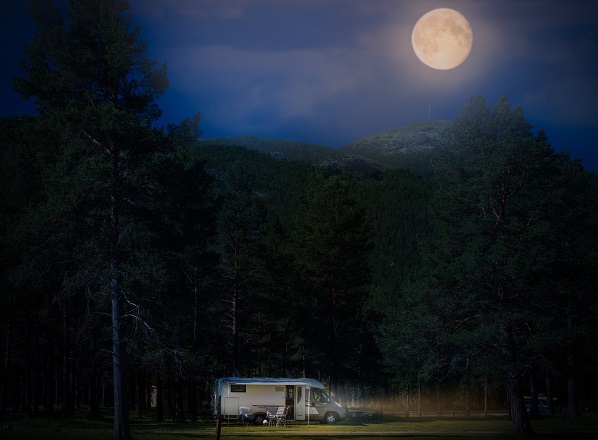
Photo by: Konstantin Yolshin
Traveling at night on long remote roads, where obstacles and wildlife may be found can be dangerous. The National Highway Traffic Safety Administration reports that driving casualties occur three times more frequently at night than in the daytime.
During the low light time of the day, the human eye has a harder time with depth perception, peripheral vision, and color determination. Also as we age, our night vision becomes worse, increasing our nighttime driving risk. Fatigue and eye strain can also lead to dangerous drowsy driving. These tips below could help improve overall safety for driving after dark.
1. Align your headlights.
Properly adjusting your headlights will help keep your beams where they are most useful for nighttime driving without blinding others approaching you.
Headlight alignment could change from your lights loosening, the location of loading weight, or tire pressure over time. Some headlights have a bubble level in the headlamp assembly to check the aim, but oftentimes you will have to do it yourself.
Check your vehicle’s owner manual to learn how to correctly adjust the aim of your high and low beams. It might take a few trials, but correcting the adjustment can make a huge difference.
2. Wash your windshield inside and out.
There is nothing worse than streaks and stains on your windshield. They can be even more noticeable at night when light bounces off of the grime.
Oil from fingers and hands touching the inside of the glass smear and linger, which can make for annoying glares. A great trick to polish glass is to use newspaper to remove the residue without leaving lint behind.
3. Avoid using other light sources.
Try to minimize your use of non-headlight light sources to keep your vision sharp and your concentration focused. You should dim your dashboard instrument panels, turn off map lights and inside reading lights, use the rear-view mirror dimmer switch, and avoid staring at the headlights of oncoming traffic.
4. Scan for animals.
Wildlife is active during nighttime hours and can often be found on roads that provide easier travel routes than other forested trails.
Animal collisions are devastating to both the animal and driver. The cover of dark can protect wildlife from predators, but also hides them from human eye detection on the roads.
Stay extra alert for animals during night hours, look ahead for retinal reflections of your headlights in the eyes of animals, and pay attention to your speed. Oftentimes you will see retinal reflections before you can see the actual animal on the road ahead.
5. Add auxiliary lights to your RV.
Fog lights not only help you see the road in the fog, but because they are positioned low to the ground, they spread wider than the low beams. These will help you see further along the shoulder of the road.
High-intensity discharge lights (HID lights) or Light-emitting diode (LED lightbars) can also add to your function of the high beams for those who do a lot of nighttime driving in light traffic areas.
These lights should be used carefully, as they can severely blind other drivers on the road. Also switching to your normal beams will then seem very dim because your eyes adjust to the brightness.
Do you have a question about RV lights? Contact us here!
